
Cybersecurity
Trojans: Hidden Threat
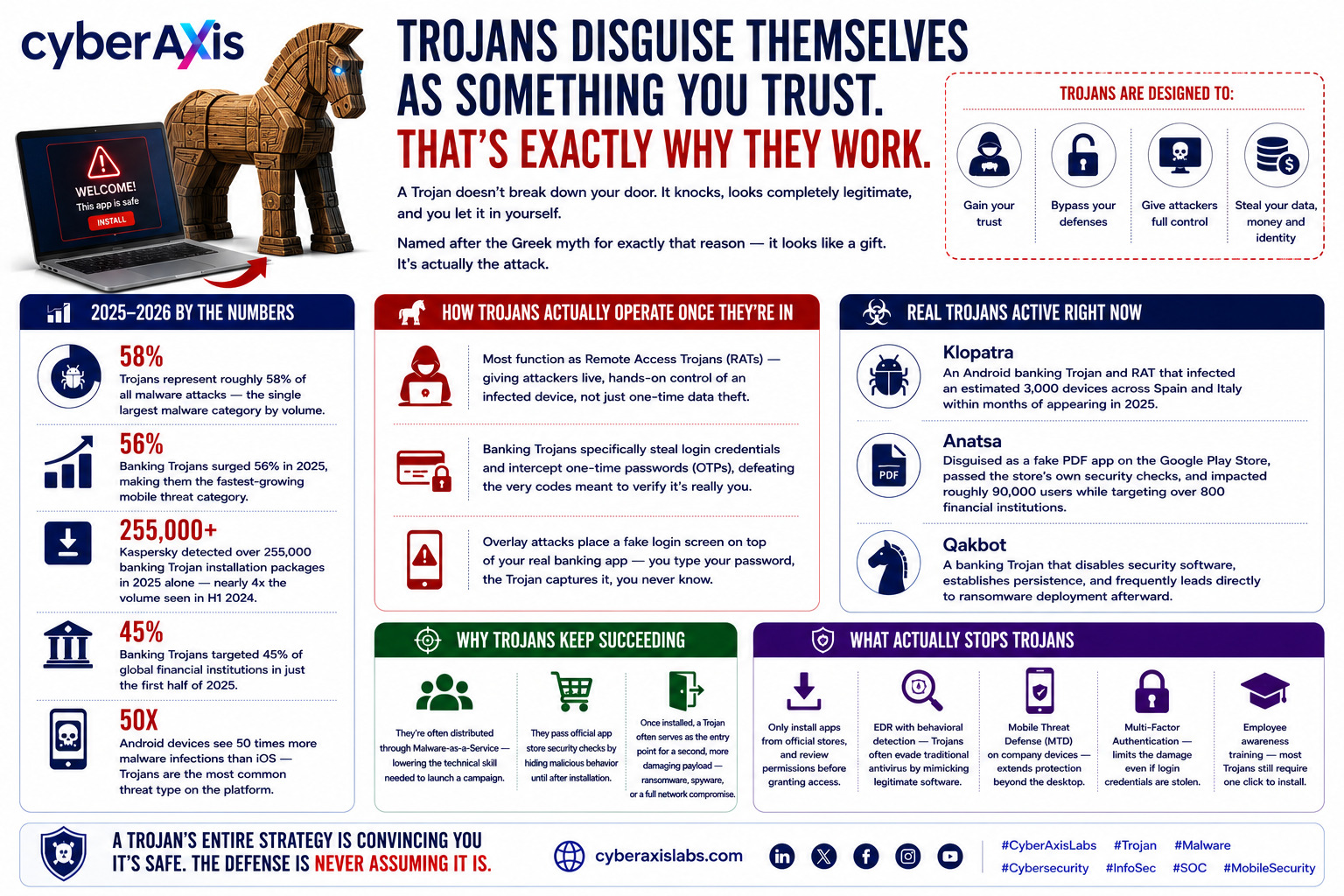
Trojans Disguise Themselves as Something You Trust. That's Exactly Why They Work.
A Trojan doesn't break down your door. It knocks, looks completely legitimate, and you let it in yourself.
Named after the Greek myth for exactly that reason — it looks like a gift. It's actually the attack.
Here's what 2025-2026 looked like:
→ Trojans represent roughly 58% of all malware attacks — the single largest malware category by volume
→ Banking Trojans surged 56% in 2025, making them the fastest-growing mobile threat category
→ Kaspersky detected over 255,000 banking Trojan installation packages in 2025 alone — nearly 4x the volume seen in H1 2024
→ Banking Trojans targeted 45% of global financial institutions in just the first half of 2025
→ Android devices see 50 times more malware infections than iOS — Trojans are the most common threat type on the platform
How Trojans actually operate once they're in:
→ Most function as Remote Access Trojans (RATs) — giving attackers live, hands-on control of an infected device, not just one-time data theft
→ Banking Trojans specifically steal login credentials and intercept one-time passwords (OTPs), defeating the very codes meant to verify it's really you
→ Overlay attacks place a fake login screen on top of your real banking app — you type your password, the Trojan captures it, you never know
Real Trojans active right now:
Klopatra — an Android banking Trojan and RAT that infected an estimated 3,000 devices across Spain and Italy within months of appearing in 2025
Anatsa — disguised as a fake PDF app on the Google Play Store, passed the store's own security checks, and impacted roughly 90,000 users while targeting over 800 financial institutions
Qakbot — a banking Trojan that disables security software, establishes persistence, and frequently leads directly to ransomware deployment afterward
Why Trojans keep succeeding:
✦ They're often distributed through Malware-as-a-Service — lowering the technical skill needed to launch a campaign
✦ They pass official app store security checks by hiding malicious behavior until after installation
✦ Once installed, a Trojan often serves as the entry point for a second, more damaging payload — ransomware, spyware, or a full network compromise
What actually stops Trojans:
→ Only install apps from official stores, and review permissions before granting access
→ EDR with behavioral detection — Trojans often evade traditional antivirus by mimicking legitimate software
→ Mobile Threat Defense (MTD) on company devices — extends protection beyond the desktop
→ Multi-Factor Authentication — limits the damage even if login credentials are stolen
→ Employee awareness training — most Trojans still require one click to install
A Trojan's entire strategy is convincing you it's safe. The defense is never assuming it is.
cyberaxislabs.com
#CyberAxisLabs #Trojan #Malware #Cybersecurity #InfoSec #SOC #MobileSecurity
We appreciate your feedback - share your comments at [email protected]
Comments 0
Email-verified comments are reviewed before they are published.