
SQL Injection Explained
A website may look secure from the outside.
It may have HTTPS, Multi-Factor Authentication, a firewall, and endpoint protection.
But what happens if the application itself trusts user input too much?
An attacker may be able to manipulate the application's database queries through something as simple as a login field or search parameter.
This attack is known as SQL Injection (SQLi).
SQL Injection remains one of the most important web application security vulnerabilities because a successful attack can expose, modify, or delete sensitive database information.
What Is SQL Injection?
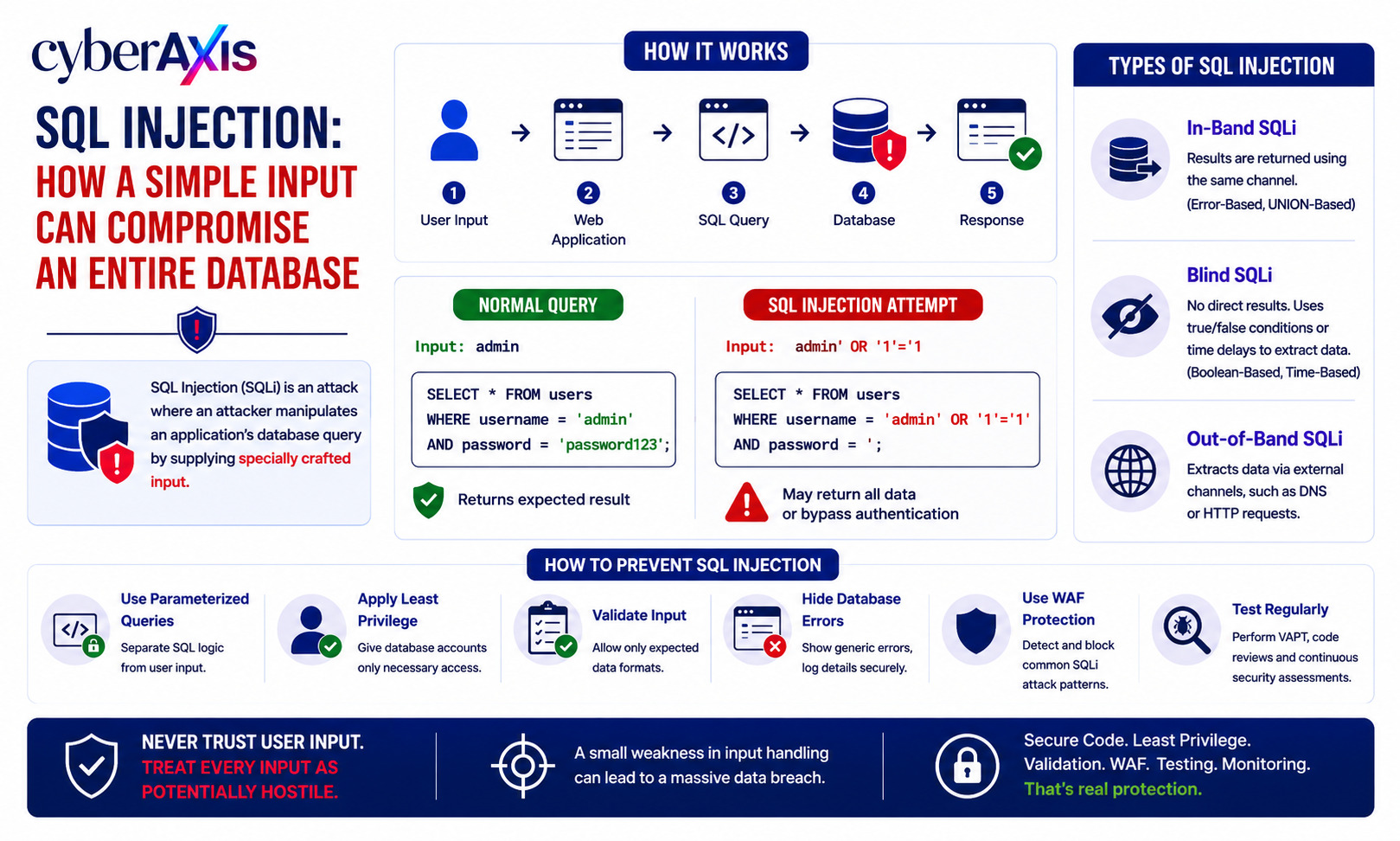
SQL Injection is an attack in which an attacker manipulates an application's database query by supplying specially crafted input.
It usually occurs when an application combines untrusted user input directly with an SQL query instead of safely separating data from SQL commands.
For example, imagine a vulnerable login application creates a query like:
SELECT * FROM users
WHERE username = '<user_input>'
AND password = '<password_input>';
If the application does not properly handle the input, an attacker may manipulate the resulting query rather than providing an ordinary username or password.
The important point is:
The attacker isn't necessarily attacking the database directly. They are abusing the application that communicates with the database.
How Does SQL Injection Work?
The attack generally follows this chain:
User Input → Web Application → SQL Query → Database → Response
If the application treats user-controlled data as part of the SQL command, an attacker may influence the query's behavior.
Simple Example
Imagine a login form in a web application where users enter their credentials:
Username: admin
Password: password123
The application may internally construct a query similar to:
SELECT * FROM users WHERE username = 'admin' AND password = 'password123';
If the application blindly inserts the id parameter into the query, an attacker may test whether unexpected SQL syntax changes the application's behavior.
During an authorized security assessment, a tester might send specially crafted input to determine whether the parameter is being safely handled.
If the application's response changes unexpectedly, it may indicate that the parameter is vulnerable to SQL Injection.
Types of SQL Injection
SQL Injection isn't limited to one technique.
1. In-Band SQL Injection
This occurs when the attacker uses the same communication channel to send the attack and receive the results.
Two common forms are:
Error-Based SQL Injection
The attacker intentionally causes database errors and analyzes the application's responses.
Detailed database error messages may reveal information about:
Database type
Table names
Column names
Query structure
Database configuration
UNION-Based SQL Injection
The attacker attempts to combine the application's original query with another query using SQL UNION functionality.
If the application is vulnerable and the database response is exposed, this may allow unauthorized information to appear in the application's response.
2. Blind SQL Injection
Sometimes an application doesn't display database errors or query results.
That doesn't necessarily mean it isn't vulnerable.
In Blind SQL Injection, the attacker determines whether their input affected the application's behavior by observing indirect responses.
For example, the application may respond differently depending on whether a database condition evaluates as true or false.
Time-Based Blind SQL Injection
Another technique involves observing response timing.
An attacker may send an input designed to cause the database to delay its response when a particular condition is true.
If the application consistently responds more slowly under the expected condition, the tester may infer information about the database.
This technique can be considerably slower than attacks where database results are directly visible.
3. Out-of-Band SQL Injection
In some situations, the vulnerable application does not return useful information through its normal response.
An attacker may attempt to make the database interact with an external system through supported database functionality.
This can provide an alternative communication channel.
Out-of-band SQL Injection is less common than some other SQLi techniques but can be significant when the application's normal response does not reveal useful information.
Realistic Example – E-Commerce Application
Consider an online shopping application.
A customer searches for a product, and the application sends the search term to the backend database.
A normal request might look like:
Search: laptop
The application searches the product database and returns matching products.
Now imagine the developer has constructed the database query by directly concatenating the search input into SQL.
An attacker begins testing the search parameter with carefully crafted input.
Instead of simply searching for a product, the attacker attempts to manipulate the application's database query.
If the application is vulnerable, the attacker may eventually be able to access information that the application was never supposed to expose.
Depending on the database permissions and application design, the consequences could include:
Unauthorized data access
Exposure of customer information
Modification of records
Deletion of data
Authentication bypass
Potential compromise of the underlying system
Lesson: A seemingly harmless search box can become a gateway to sensitive database information when user input isn't handled securely.
What Can Attackers Gain?
The impact depends heavily on the application's architecture and database privileges.
A successful SQL Injection attack may allow attackers to:
Read confidential information
Access customer records
Modify database records
Delete information
Bypass application authentication
Extract credentials or password hashes
Access internal application data
Potentially escalate the attack beyond the database
The severity increases when the application's database account has excessive privileges.
For example:
Application → Database Account → Excessive Permissions
If the database account can perform unnecessary administrative operations, a vulnerability in the application can have a much greater impact.
Why SQL Injection Happens
SQL Injection is usually caused by insecure application development practices.
Common causes include:
❌ Dynamic SQL with Untrusted Input
Applications directly concatenate user input into SQL queries.
❌ Lack of Input Validation
The application doesn't properly validate what users are allowed to submit.
❌ Excessive Database Privileges
The application's database account has more permissions than it actually needs.
❌ Poor Error Handling
Detailed database errors are displayed to users.
❌ Legacy Code
Older applications may contain vulnerable database interaction patterns.
❌ Insufficient Security Testing
SQL Injection vulnerabilities can remain undetected when applications aren't regularly tested.
How to Prevent SQL Injection
The strongest defense is to ensure that user input is treated as data—not executable SQL.
1. Use Parameterized Queries
Parameterized queries, also known as prepared statements, separate SQL instructions from user-provided data.
Instead of constructing SQL dynamically, the application sends the SQL structure and the values separately.
This is one of the most effective defenses against SQL Injection.
2. Use Safe ORM Features
Modern Object-Relational Mapping (ORM) frameworks can reduce SQL Injection risks when their parameterized APIs are used correctly.
However, developers should not assume that using an ORM automatically makes an application secure.
Unsafe raw SQL can still introduce vulnerabilities.
3. Validate Input
Apply appropriate validation based on the expected input.
For example, if a parameter should contain a numeric product ID, the application should validate that it conforms to the expected format.
Important: Input validation should complement parameterized queries, not replace them.
4. Apply Least Privilege
The application's database account should have only the permissions it requires.
If a web application only needs to read and update specific tables, it shouldn't have administrative database privileges.
Less privilege = less potential damage.
5. Don't Expose Database Errors
Users shouldn't receive detailed database errors containing:
SQL statements
Table names
Database configuration
Internal paths
Stack traces
Instead, applications should return safe, generic error messages while recording useful technical details securely in server-side logs.
6. Use a Web Application Firewall
A WAF can help identify and block common SQL Injection patterns.
However, a WAF should be considered an additional security layer—not a replacement for fixing vulnerable application code.
7. Perform Regular Security Testing
Organizations should regularly perform:
Vulnerability assessments
Web application penetration testing
Secure code reviews
API security testing
Dependency and configuration reviews
Testing should cover both authenticated and unauthenticated application functionality.
How Can a SOC Detect SQL Injection?
SQL Injection isn't only an AppSec problem.
A SOC can also help detect attacks by monitoring application and infrastructure telemetry.
Security teams can look for:
Large numbers of unusual requests to application endpoints
Repeated requests containing suspicious SQL syntax
Abnormal HTTP response patterns
Database errors occurring repeatedly
Unexpected database queries
Unusual database access from application servers
Sudden increases in database activity
Requests originating from suspicious IP addresses
WAF alerts associated with SQL Injection attempts
For example:
WAF Alert → Web Server Logs → Application Logs → Database Activity → SOC Investigation
Correlating these events can help determine whether an attacker is merely scanning the application or has successfully exploited a vulnerability.
SQL Injection in VAPT
During an authorized Vulnerability Assessment and Penetration Test, security professionals typically examine application inputs such as:
Login forms
Search fields
URL parameters
API parameters
HTTP headers
Cookies
POST parameters
The objective is to determine whether untrusted input can alter backend database behavior.
A professional assessment should avoid unnecessary data modification or destructive actions.
The goal is to prove the vulnerability safely and provide remediation guidance, not to damage the client's environment.
Final Thoughts
SQL Injection demonstrates an important cybersecurity principle:
A small application weakness can create a much larger security problem.
An attacker doesn't necessarily need to break through a firewall or compromise a server directly.
Sometimes, all they need is an application that trusts user input too much.
The best defense is not a single security product.
It is a combination of:
Secure Coding + Parameterized Queries + Least Privilege + Input Validation + WAF + Security Testing + Continuous Monitoring
SQL Injection has been known for decades, yet it continues to appear in vulnerable applications.
The lesson is simple:
Never trust user input. Treat every input as potentially hostile until your application has handled it securely.



Comments 0
Email-verified comments are reviewed before they are published.