
Man-in-the-Middle (MitM) Attack
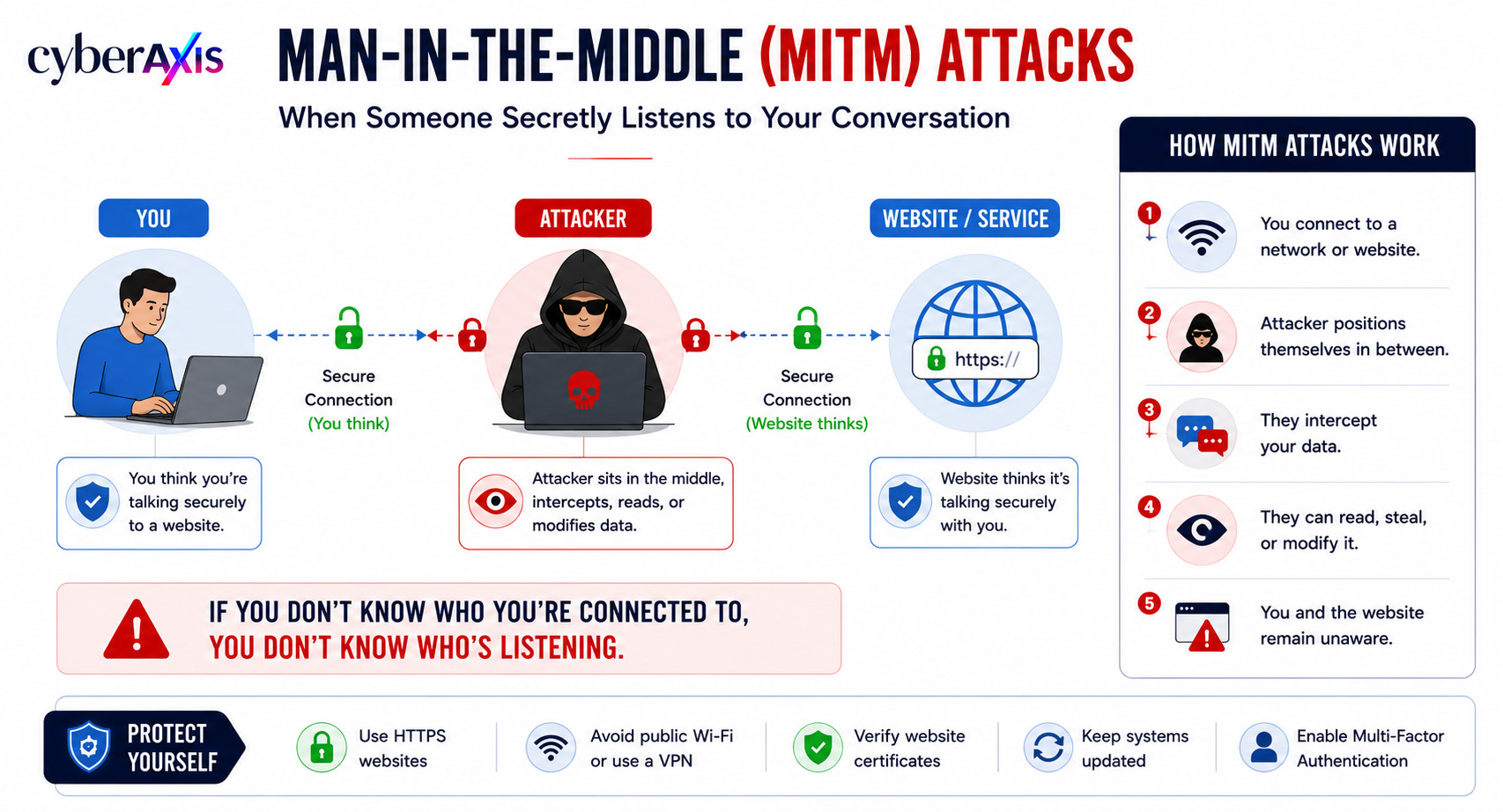
Man-in-the-Middle (MitM) Attacks: When Someone Secretly Listens to Your Conversation
When you send an email, log in to your bank, or connect to public Wi-Fi, you expect your device to communicate directly with the website or service.
But what if someone quietly positioned themselves between you and the destination?
That's exactly how a Man-in-the-Middle (MitM) attack works.
Instead of attacking your device directly, the attacker intercepts or manipulates the communication between two trusted parties—often without either side realizing it.
What Is a Man-in-the-Middle Attack?
A Man-in-the-Middle (MitM) attack occurs when an attacker secretly intercepts communication between two parties.
Rather than breaking into your account, the attacker acts as an invisible middleman, allowing them to:
Capture usernames and passwords
Steal banking or payment information
Read sensitive business data
Modify messages before they reach the recipient
Redirect users to malicious websites
If the communication isn't properly secured, both parties believe they are communicating directly with each other.
How Do MitM Attacks Happen?
Attackers use several techniques, including:
Rogue or fake public Wi-Fi hotspots
ARP Spoofing on local networks
DNS Spoofing to redirect users to fake websites
SSL Stripping to downgrade encrypted connections
Malicious proxies or compromised network devices
The goal is simple—intercept, monitor, or manipulate data without being noticed.
Scenario 1 – Fake Public Wi-Fi
Nikhil, An employee is works at a coffee shop, one day he notices a Wi-Fi network named "Free Coffee WiFi."
Believing it to be the official network, they connect without verifying it.
The Wi-Fi hotspot is actually controlled by an attacker.
As the employee browses websites, signs in to business applications, and checks email, the attacker monitors the network traffic and attempts to capture sensitive information or redirect the user to fake login pages.
The employee has no idea someone is sitting in the middle of the communication.
Lesson: Never assume a public Wi-Fi network is legitimate simply because its name looks familiar.
Scenario 2 – ARP Spoofing Inside the Office
An attacker gains access to a company's internal network through a compromised device.
They launch an ARP Spoofing attack, convincing employee computers that the attacker's device is the network gateway.
From that moment, network traffic begins flowing through the attacker's system before reaching its intended destination.
The attacker silently monitors communications, captures sensitive information, and can even modify unencrypted traffic without users noticing.
Lesson: Internal networks aren't automatically safe. Network segmentation, encryption, and monitoring are essential defenses.
Why MitM Attacks Are Dangerous
A successful Man-in-the-Middle attack can allow attackers to:
Steal usernames and passwords
Capture financial information
Monitor sensitive communications
Modify data in transit
Redirect users to phishing websites
Compromise business accounts
Because the attacker sits silently between two trusted parties, the attack often goes unnoticed.
Quick Tips to Protect Yourself
Avoid connecting to unknown or unsecured public Wi-Fi networks.
Verify website addresses and ensure HTTPS is enabled.
Use a trusted VPN when accessing public networks.
Never ignore browser security or certificate warnings.
Keep your devices and browsers updated.
Enable Multi-Factor Authentication (MFA) on important accounts.
Use encrypted protocols such as HTTPS, SSH, and TLS.
Report unusual network behavior to your IT or Security team.
Final Thoughts
Man-in-the-Middle attacks don't always rely on malware or stolen passwords.
Instead, they exploit insecure communications and misplaced trust.
By using encrypted connections, verifying networks, and staying alert to suspicious behavior, both individuals and organizations can significantly reduce the risk of becoming victims.
Remember: If you don't know who you're connected to, you don't know who's listening.



Comments 0
Email-verified comments are reviewed before they are published.