
Palo Alto Networks Cortex XSIAM
Modern SOC teams deal with a huge amount of security data.
Endpoints, firewalls, networks, cloud environments, identities, applications, and other security tools continuously generate events and alerts.
The challenge is not simply collecting this data.
The real challenge is finding real threats, understanding the attack, and responding quickly.
This is where Palo Alto Networks Cortex XSIAM comes in.
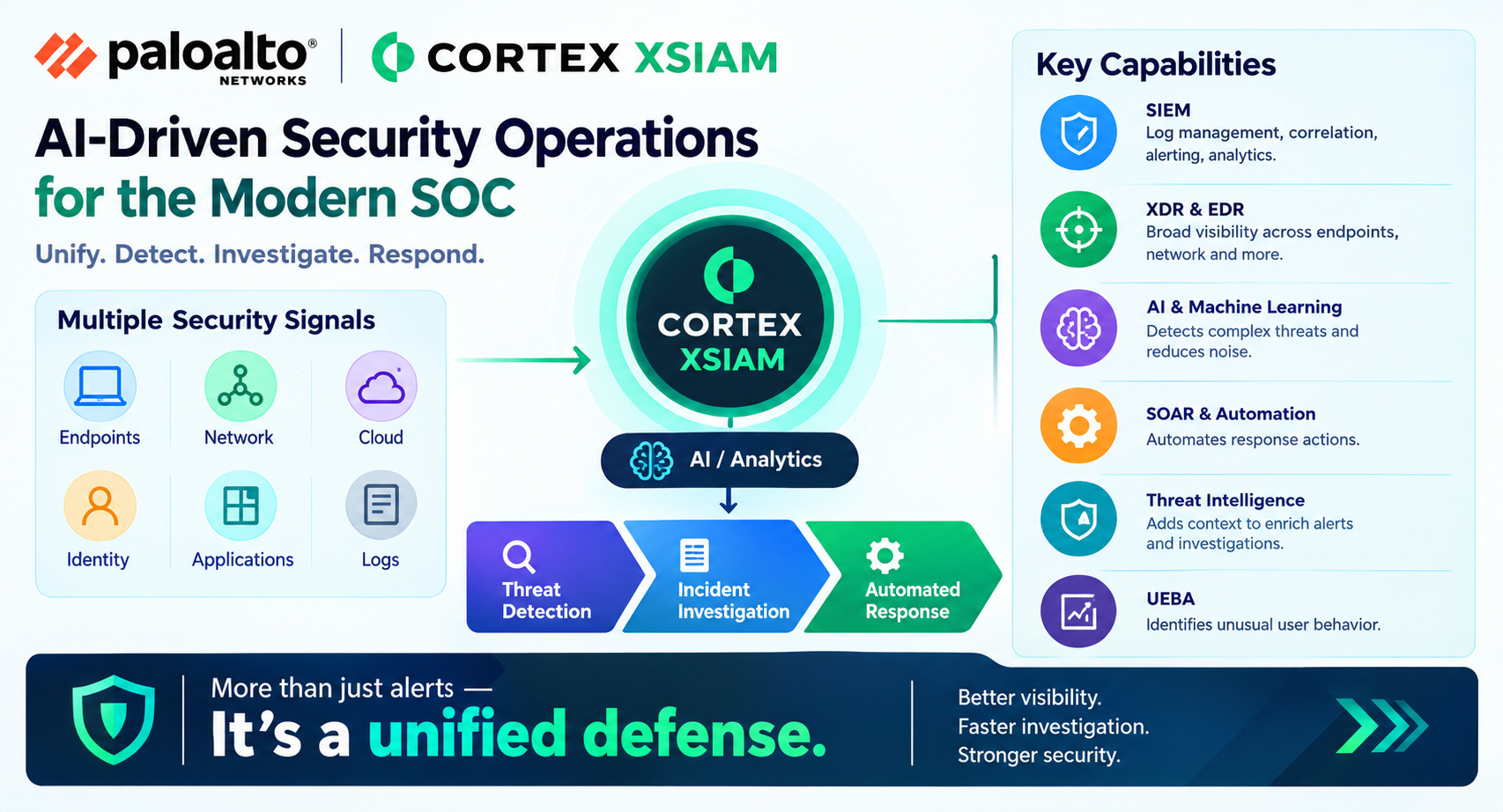
Cortex XSIAM is an AI-driven security operations platform that brings together capabilities such as SIEM, XDR, EDR, SOAR, threat intelligence, UEBA, and attack surface management into a unified platform.
What Is Cortex XSIAM?
XSIAM stands for Extended Security Intelligence and Automation Management.
The goal of XSIAM is to centralize security operations instead of requiring analysts to work across many separate security consoles.
A simplified view is:
Endpoint + Network + Cloud + Identity + Logs
↓
Cortex XSIAM
↓
AI / Analytics
↓
Threat Detection
↓
Incident Investigation
↓
Automated Response
Palo Alto Networks describes XSIAM as an AI-driven security operations platform designed to unify data, detection, investigation, and automation for the modern SOC.
Why Do Organizations Use Cortex XSIAM?
One major reason is reducing security complexity.
A traditional SOC may use separate tools for:
SIEM → Logs
EDR → Endpoints
NDR → Network
SOAR → Automation
TIP → Threat Intelligence
UEBA → User Behavior
This can require analysts to switch between multiple consoles.
Cortex XSIAM brings many of these capabilities together in one platform, reducing the need for constant console switching.
How Does Cortex XSIAM Work?
A simplified process looks like:
Collect
XSIAM collects security telemetry from endpoints, networks, cloud, identity systems, and other sources.
↓
Analyze
The platform applies analytics and machine-learning models to the collected data.
↓
Correlate
Related events are connected to identify a broader attack.
↓
Prioritize
Security teams can focus on incidents that require attention instead of treating every event equally.
↓
Respond
Automation can perform supported response actions to help contain and remediate threats.
Key Capabilities of Cortex XSIAM
1. SIEM
XSIAM provides SIEM capabilities including:
Log management
Event correlation
Alerting
Security analytics
Investigation
This allows security teams to analyze security data from multiple sources within the same platform.
2. XDR and EDR
XSIAM integrates endpoint, network, and other telemetry to detect threats across multiple attack surfaces.
The endpoint component provides detailed endpoint telemetry for detection, investigation, and response.
3. AI and Machine Learning
A major part of XSIAM is its use of machine learning and analytics to identify suspicious behavior and reduce manual investigation work.
Instead of simply generating large numbers of alerts, the platform is designed to connect related events and turn them into meaningful incidents.
4. SOAR and Automation
XSIAM includes automation capabilities that can perform response actions with less manual intervention.
For example, certain threats may trigger automated containment or remediation actions, depending on the environment and configuration.
5. Threat Intelligence
Threat intelligence can be used to enrich alerts and incidents with additional context about suspicious indicators and threats.
Realistic Example – Detecting a Multi-Stage Attack
Imagine an attacker compromises an employee's laptop.
The attack produces several events:
Suspicious process starts
↓
Endpoint connects to an unusual destination
↓
Credential-related activity occurs
↓
The attacker attempts to access another system
A traditional SOC may receive separate alerts from endpoint, network, and identity tools.
Cortex XSIAM can correlate these signals and provide a more complete incident view.
The analyst can investigate:
What started the attack?
Which endpoint was affected?
Which accounts were involved?
What systems were accessed?
What should be contained?
This helps the SOC focus on the attack story, rather than investigating every event in isolation.
Cortex XSIAM in a SOC
A practical SOC workflow can look like:
Security Data
↓
Cortex XSIAM
↓
Detection & Correlation
↓
Incident
↓
Triage
↓
Investigation
↓
Automated / Analyst Response
↓
Remediation
This approach is designed to reduce repetitive analyst tasks and help security teams respond faster to incidents that require human investigation.
Cortex XSIAM vs Traditional SIEM
Traditional SIEM platforms primarily focus on collecting, storing, searching, and correlating security data.
Cortex XSIAM goes beyond this model by combining SIEM with capabilities such as:
XDR + EDR + SOAR + UEBA + Threat Intelligence + Exposure Management
The objective is to create a more unified security operations platform rather than maintaining multiple disconnected tools.
Why Should SOC Analysts Learn Cortex XSIAM?
For SOC and blue-team professionals, learning XSIAM provides exposure to:
SIEM
XDR
EDR
Threat Detection
Incident Investigation
Security Analytics
Threat Intelligence
SOAR and Automation
UEBA
It also helps analysts understand how modern SOC platforms are moving from simple alert monitoring toward automated, intelligence-driven detection and response.
Final Thoughts
Cyberattacks increasingly involve multiple systems and security layers.
An attack may move from:
Endpoint → Identity → Network → Cloud → Data
A SOC therefore needs more than isolated security alerts.
Cortex XSIAM is designed to bring security data and SOC capabilities together, apply analytics and AI, correlate threats, prioritize incidents, and automate response actions where appropriate.
The key idea behind Cortex XSIAM is simple: collect more relevant security data, connect the signals, reduce unnecessary noise, and help the SOC respond to real threats faster.
Remember: XSIAM is not just about collecting alerts. It is about turning security data into connected incidents and actionable security intelligence.



Comments 0
Email-verified comments are reviewed before they are published.