
Cybersecurity
Deepfake Scams Explained
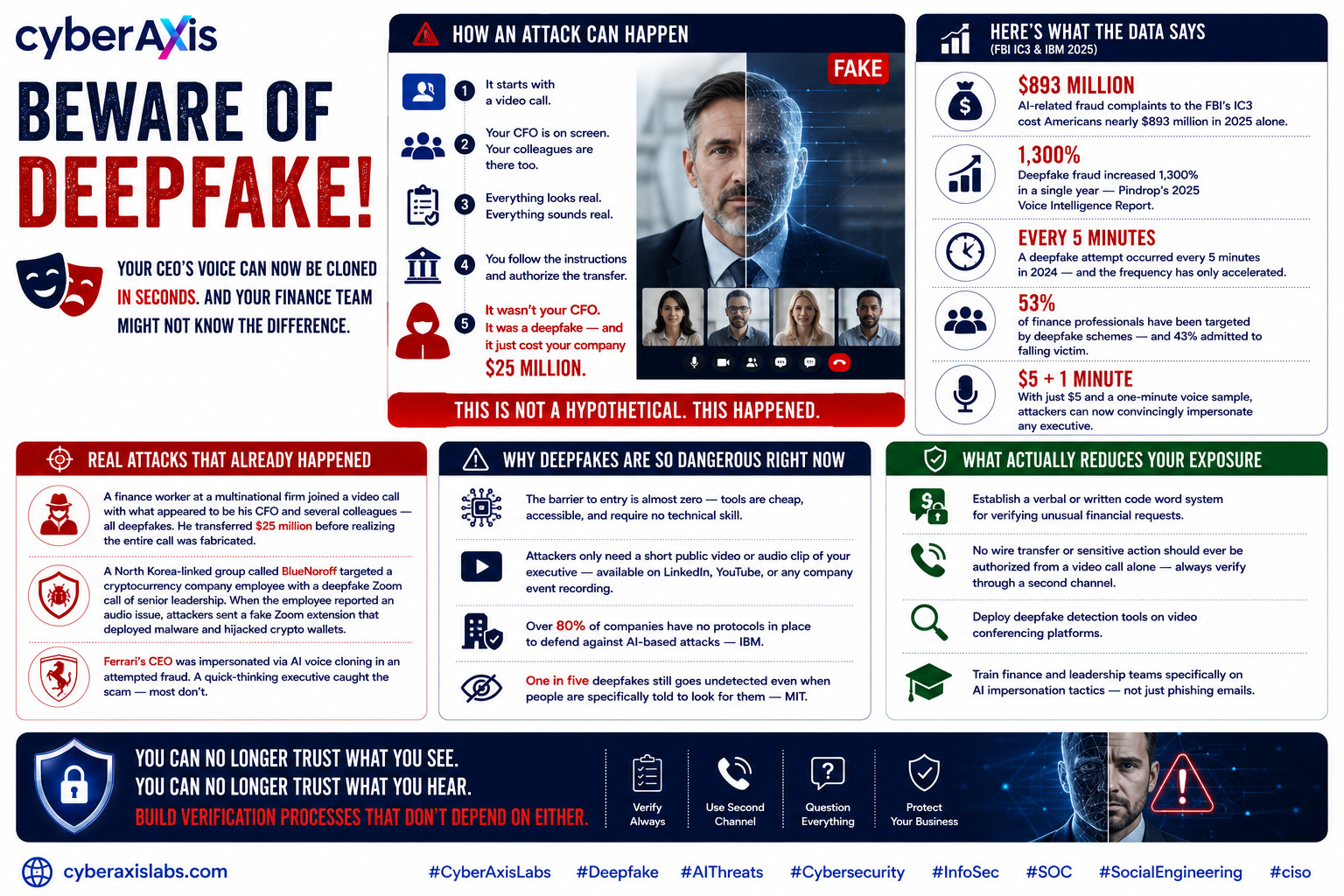
Beware of Deepfake!
Your CEO's Voice Can Now Be Cloned in Seconds. And Your Finance Team Might Not Know the Difference.
It starts with a video call.
Your CFO is on screen. Your colleagues are there too.
Everything looks real. Everything sounds real.
You follow the instructions and authorize the transfer.
It wasn't your CFO. It was a deepfake — and it just cost your company $25 million.
This is not a hypothetical. This happened.
Here's what the data says (FBI IC3 & IBM 2025):
→ AI-related fraud complaints to the FBI's IC3 cost Americans nearly $893 million in 2025 alone
→ Deepfake fraud increased 1,300% in a single year — Pindrop's 2025 Voice Intelligence Report
→ A deepfake attempt occurred every 5 minutes in 2024 — and the frequency has only accelerated
→ 53% of finance professionals have been targeted by deepfake schemes — and 43% admitted to falling victim
→ With just $5 and a one-minute voice sample, attackers can now convincingly impersonate any executive
Real attacks that already happened:
A finance worker at a multinational firm joined a video call with what appeared to be his CFO and several colleagues — all deepfakes. He transferred $25 million before realizing the entire call was fabricated.
A North Korea-linked group called BlueNoroff targeted a cryptocurrency company employee with a deepfake Zoom call of senior leadership. When the employee reported an audio issue, attackers sent a fake Zoom extension that deployed malware and hijacked crypto wallets.
Ferrari's CEO was impersonated via AI voice cloning in an attempted fraud. A quick-thinking executive caught the scam — most don't.
Why deepfakes are so dangerous right now:
✦ The barrier to entry is almost zero — tools are cheap, accessible, and require no technical skill
✦ Attackers only need a short public video or audio clip of your executive — available on LinkedIn, YouTube, or any company event recording
✦ Over 80% of companies have no protocols in place to defend against AI-based attacks — IBM
✦ One in five deepfakes still goes undetected even when people are specifically told to look for them — MIT
What actually reduces your exposure:
→ Establish a verbal or written code word system for verifying unusual financial requests
→ No wire transfer or sensitive action should ever be authorized from a video call alone — always verify through a second channel
→ Deploy deepfake detection tools on video conferencing platforms
→ Train finance and leadership teams specifically on AI impersonation tactics — not just phishing emails
You can no longer trust what you see. You can no longer trust what you hear.
Build verification processes that don't depend on either.
cyberaxislabs.com
#CyberAxisLabs #Deepfake #AIThreats #Cybersecurity #InfoSec #SOC #SocialEngineering #ciso
We appreciate your feedback - share your comments at [email protected]



Comments 0
Email-verified comments are reviewed before they are published.