
Web Application Penetration Testing
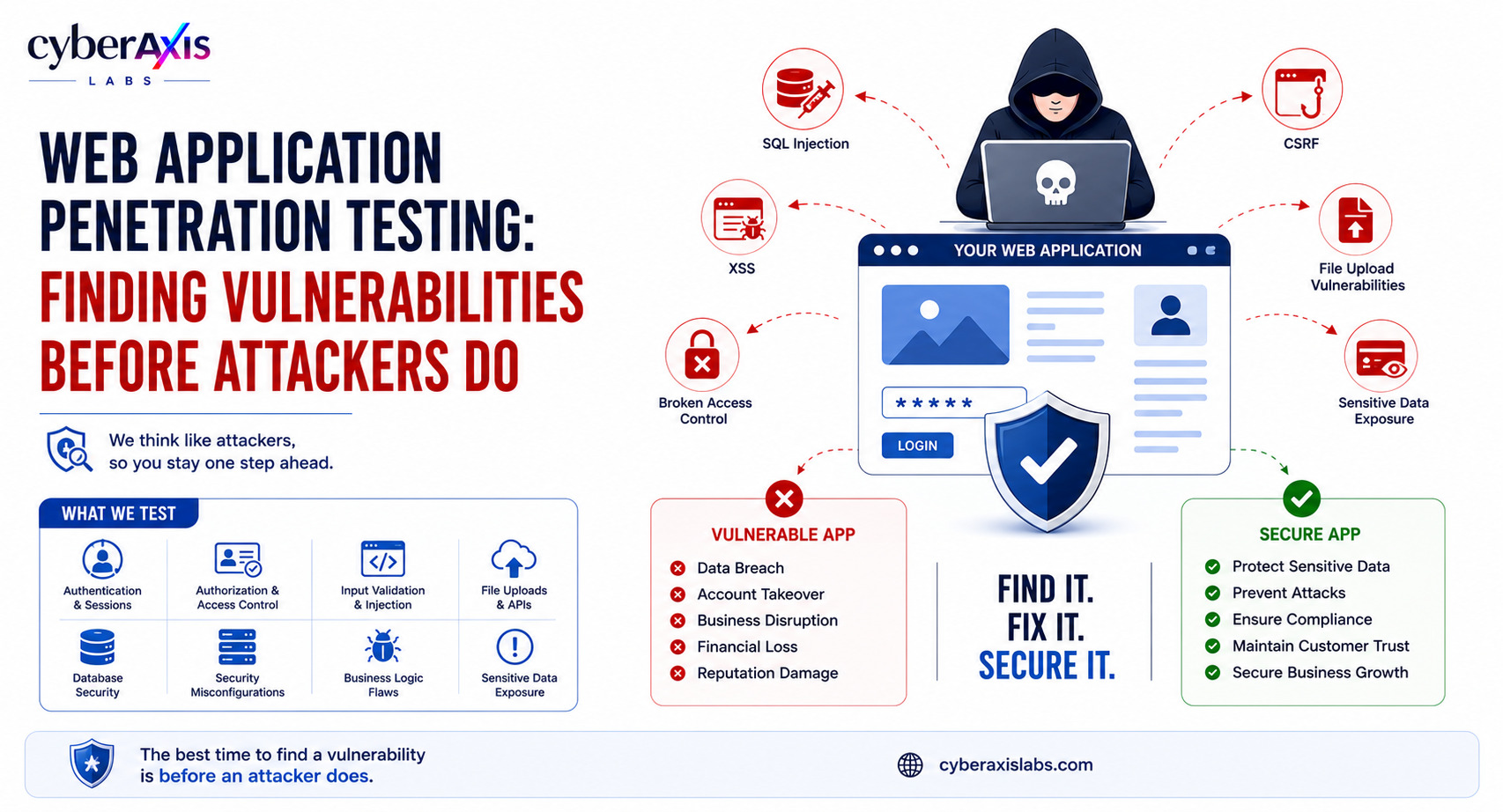
Today, almost every business relies on web applications—customer portals, e-commerce websites, HR systems, online banking, healthcare portals, SaaS platforms, and internal business applications.
Unfortunately, attackers rely on them too.
Every day, cybercriminals scan the internet looking for vulnerable web applications they can exploit to steal sensitive information, gain unauthorized access, deploy ransomware, or disrupt business operations.
The good news?
Organizations don't have to wait for attackers to discover these weaknesses first.
That's exactly why Web Application Penetration Testing (Web App Pentesting) exists.
What Is Web Application Penetration Testing?
Web Application Penetration Testing is an authorized security assessment that simulates how a real attacker would attempt to compromise a web application.
The objective isn't to damage the application.
The objective is to identify and validate security vulnerabilities before cybercriminals can exploit them.
A penetration test doesn't just identify vulnerabilities—it demonstrates how they could impact the business and provides recommendations to remediate them.
What Do Penetration Testers Look For?
During a web application penetration test, security professionals commonly assess:
Authentication and login security
Session management
Authorization and access control
Input validation
Business logic flaws
File upload functionality
API security
Database security
Sensitive data exposure
Security misconfigurations
Server-side vulnerabilities
Client-side vulnerabilities
Many of these tests align with the OWASP Top 10, one of the most widely recognized standards for web application security.
Common Vulnerabilities Attackers Exploit
Some of the most common web application vulnerabilities include:
SQL Injection (SQLi)
Cross-Site Scripting (XSS)
Broken Access Control
Cross-Site Request Forgery (CSRF)
Insecure File Uploads
Server-Side Request Forgery (SSRF)
Remote Code Execution (RCE)
Security Misconfigurations
Weak Authentication
Sensitive Data Exposure
Even a single vulnerability can provide attackers with a path into an organization's environment.
Scenario 1 – SQL Injection
A retail company launches an online customer portal.
An attacker discovers that the application's login page fails to properly validate user input.
By injecting malicious SQL commands into the login form, the attacker bypasses authentication and gains unauthorized access to the backend database.
Customer records, order history, and personal information become exposed.
Lesson: Always validate user input, use parameterized queries (prepared statements), and never build SQL queries by concatenating user input.
Scenario 2 – Broken Access Control
A company provides a customer portal where users can view and update their personal profile, order history, and billing information.
The application uses predictable user IDs in the URL, such as:
/profile?id=1025
An attacker simply changes the ID to another value:
/profile?id=1026
Because the application doesn't properly verify whether the user is authorized to access that record, the attacker can view another customer's private information.
Addresses, order history, invoices, and personal details become exposed without exploiting any sophisticated vulnerability.
Lesson: Always enforce authorization checks on the server side and ensure users can access only the resources they are permitted to view.
Scenario 3 – Cross-Site Scripting (XSS)
A company's customer support portal allows users to submit feedback that is later displayed on an internal dashboard for support agents.
The application fails to properly validate and sanitize user input before displaying it.
An attacker submits feedback containing a malicious JavaScript payload instead of plain text.
When a support agent opens the feedback, the malicious script automatically executes in the browser.
The script steals the agent's authenticated session cookie and sends it to the attacker.
The attacker then imports the stolen session into their own browser and gains unauthorized access to the support portal as the legitimate user.
Lesson: Validate and sanitize all user input, encode output before displaying it, implement a strong Content Security Policy (CSP), and mark session cookies as HttpOnly to reduce the impact of XSS attacks.
Why Web Application Penetration Testing Matters
Without regular security testing, organizations risk:
Data breaches
Customer information exposure
Financial loss
Website defacement
Account compromise
Business disruption
Regulatory penalties
Damage to business reputation
Finding vulnerabilities before attackers do is significantly less expensive than responding to a successful breach.
How Can Organizations Protect Their Web Applications?
Building secure web applications requires multiple layers of defense. Organizations should:
Follow secure coding practices throughout the Software Development Life Cycle (SDLC).
Validate and sanitize all user input.
Use parameterized queries or prepared statements to prevent SQL Injection.
Encode output to reduce the risk of Cross-Site Scripting (XSS).
Implement strong authentication and Multi-Factor Authentication (MFA).
Enforce proper authorization and role-based access control.
Apply the principle of least privilege.
Secure session management using Secure, HttpOnly, and SameSite cookies.
Protect against CSRF using anti-CSRF tokens.
Validate and securely handle file uploads.
Encrypt sensitive data both in transit and at rest.
Deploy a Web Application Firewall (WAF).
Apply security headers such as Content Security Policy (CSP), X-Frame-Options, and X-Content-Type-Options.
Keep frameworks, libraries, plugins, and servers updated with the latest security patches.
Perform regular vulnerability assessments and penetration testing.
Continuously monitor application logs and security events.
Train developers on secure coding practices and the OWASP Top 10.
Benefits of Regular Penetration Testing
Regular web application penetration testing helps organizations:
Identify vulnerabilities before attackers do.
Validate the effectiveness of existing security controls.
Reduce the likelihood of data breaches.
Meet regulatory and compliance requirements.
Improve customer trust.
Reduce remediation costs by fixing issues early.
Strengthen the organization's overall security posture.
Security is not a one-time activity. Every new feature, software update, or third-party integration can introduce new vulnerabilities.
Final Thoughts
Attackers don't need to break into your network if they can break into your web application.
Every login page, search box, contact form, API endpoint, and file upload feature is a potential attack surface if not properly secured.
Web Application Penetration Testing helps organizations identify and remediate these weaknesses before they become costly security incidents.
In today's threat landscape, regularly testing your web applications isn't just a security best practice—it's a business necessity.
Remember: The best time to find a vulnerability is before an attacker does.



Comments 0
Email-verified comments are reviewed before they are published.