
USB Drop Attack Explained
Someone Left a USB Drive in Your Office Parking Lot.
Your colleague saw it on the way in.
Picked it up.
Thought — "let me check whose this is."
Plugged it into their work laptop.
Within 30 seconds, malware was already executing silently in the background.
They went about their day. Attended meetings. Had lunch. Sent emails.
Nobody knew.
47 days later — your company discovered it had been completely compromised.
This is a USB Drop Attack. And it is one of the most consistently successful social engineering attacks in cybersecurity — because it doesn't exploit your systems.
It exploits human curiosity.
How it works:
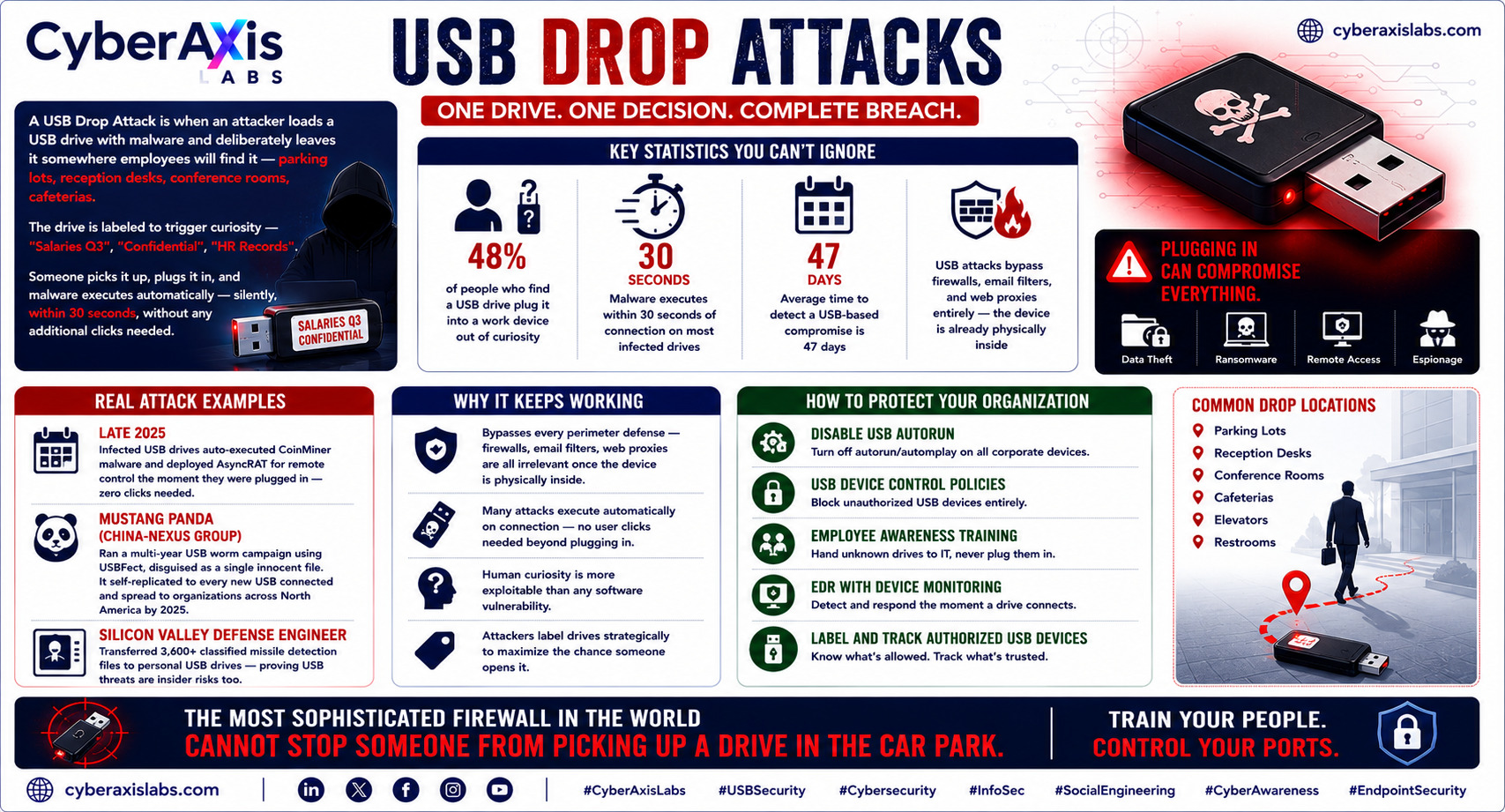
An attacker loads a USB drive with malware — ransomware, a keylogger, or a remote access tool. They drop it somewhere it will be found — a parking lot, a reception desk, a conference room, a cafeteria.
The label on the drive does the rest.
"Salaries Q3." "Confidential." "HR Records."
Someone always plugs it in.
Real attacks. Real damage (CrowdStrike 2025-2026):
In late 2025, infected USB drives automatically executed hidden malware the moment they were connected — deploying AsyncRAT to silently establish remote control across entire networks.
China-nexus group MUSTANG PANDA ran a multi-year USB worm campaign disguised as a single innocent-looking file. One click launched the worm, established persistence, and automatically spread to every new USB drive connected afterward — reaching organizations across North America by 2025.
A Silicon Valley defense engineer transferred over 3,600 classified missile detection files to personal USB drives — proving USB threats are not just external attacks but insider risks too.
Why it keeps working in 2026:
✦ A USB drive bypasses every perimeter defense — firewalls and email filters are irrelevant once it is physically inside
✦ Many attacks execute automatically on connection — no clicks needed beyond plugging in
✦ Human curiosity is more exploitable than any software vulnerability
What actually stops it:
→ Disable USB autorun on all corporate devices
→ USB device control policies — block unauthorized devices entirely
→ Employee training — hand unknown drives to IT, never plug them in
→ EDR with device monitoring — detect threats the moment a drive connects
The most sophisticated firewall in the world cannot stop someone from picking up a drive in the car park.
Train your people. Control your ports.
#CyberAxisLabs #USBSecurity #Cybersecurity #InfoSec #SocialEngineering #CyberAwareness #EndpointSecurity
We appreciate your feedback - share your comments at [email protected]



Comments 0
Email-verified comments are reviewed before they are published.