
Advanced Persistent Threat (APT)
When people think about cyberattacks, they often imagine ransomware encrypting files or hackers breaking into systems within minutes.
But some of the most dangerous attacks don't happen that way.
Instead of creating immediate disruption, attackers quietly infiltrate an organization's network, remain hidden for weeks or even months, and slowly steal valuable information without anyone noticing.
This type of attack is known as an Advanced Persistent Threat (APT).
Unlike typical cyberattacks that aim for quick financial gain, APT attacks are carefully planned, highly targeted, and designed to maintain long-term access to an organization's environment.
What Is an Advanced Persistent Threat (APT)?
An Advanced Persistent Threat (APT) is a sophisticated cyberattack in which an attacker gains unauthorized access to a network and remains undetected while continuously collecting sensitive information.
Let's break down the name:
Advanced – Attackers use sophisticated techniques, custom malware, and multiple attack methods.
Persistent – They maintain access for an extended period instead of leaving after the initial compromise.
Threat – Their objective is to steal sensitive information, monitor business activities, or prepare for future attacks.
Unlike ransomware, which announces its presence immediately, an APT succeeds by remaining invisible.
How Does an APT Attack Work?
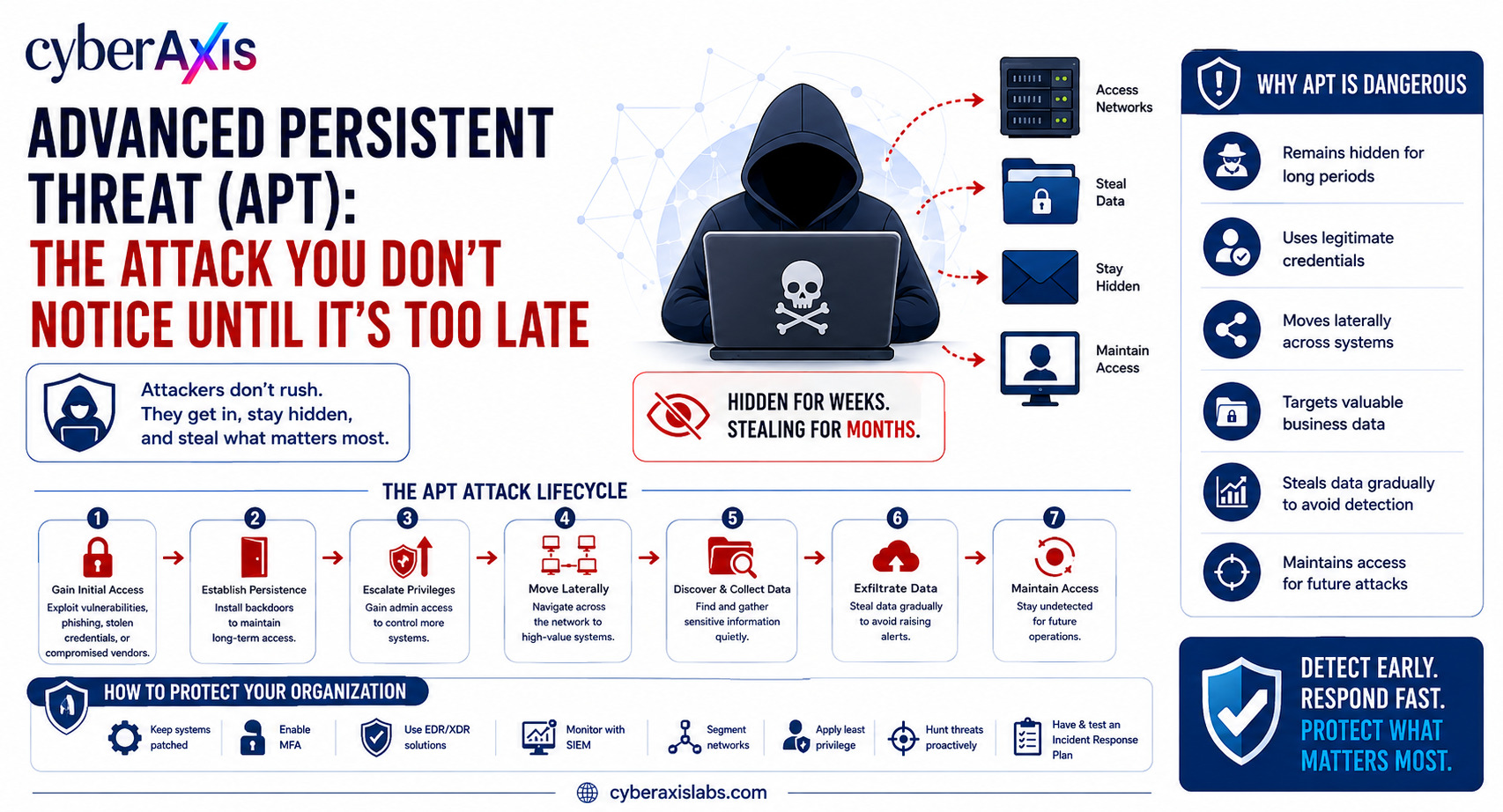
Although every attack is different, most APT campaigns follow a similar lifecycle:
Gain initial access through software vulnerabilities, stolen credentials, compromised vendors, or other attack vectors.
Install backdoors or persistence mechanisms.
Escalate privileges to gain administrative access.
Move laterally across the network to reach valuable systems.
Discover and collect sensitive information.
Exfiltrate data gradually while avoiding detection.
Maintain long-term access for future operations.
The goal is not speed.
The goal is stealth.
Scenario 1 – Dormant Malware
An organization delays applying a security update to an internet-facing application.
An attacker exploits the vulnerability and quietly installs a backdoor on the server.
Instead of launching an immediate attack, the malware remains dormant for several weeks to avoid detection.
During that time, it silently collects user credentials, monitors employee activity, and waits for an administrator to log in.
Once privileged credentials are obtained, the attacker moves laterally across the network, compromises multiple systems, and gradually exfiltrates confidential business data over several months.
Because the activity closely resembles normal business operations, the attack remains undetected until the Security Operations Center (SOC) notices unusual outbound network traffic during routine monitoring.
Lesson: APT attackers don't always act immediately. Sometimes the most dangerous malware is the one that waits patiently for the right opportunity.
Scenario 2 – Intellectual Property Theft
A technology company is developing a new product expected to give it a competitive advantage.
Unknown to the organization, attackers have maintained unauthorized access to its network for nearly eight months.
Rather than disrupting operations, they quietly collect product designs, engineering documents, research reports, source code, and strategic business plans.
The attackers avoid triggering security alerts by stealing small amounts of data over time.
The breach is finally discovered during a forensic investigation after unusual network behavior is detected.
Although no systems were encrypted and business operations continued normally, years of valuable intellectual property had already been stolen.
Lesson: Not every cyberattack is designed to disrupt your business. Some attackers simply want your most valuable information—and they're willing to remain hidden for months to obtain it.
Why Are APT Attacks So Dangerous?
APT attacks are particularly dangerous because attackers:
Remain hidden for long periods.
Use legitimate credentials to blend into normal activity.
Move laterally across multiple systems.
Target high-value business information.
Steal data gradually to avoid detection.
Maintain persistence even after some systems are cleaned.
By the time an APT is discovered, significant damage may already have occurred.
How Can Organizations Protect Themselves?
No single security solution can stop every APT attack. Organizations should adopt a layered security approach:
Apply security patches promptly, especially for internet-facing systems.
Enable Multi-Factor Authentication (MFA).
Deploy Endpoint Detection and Response (EDR/XDR).
Continuously monitor logs using a SIEM solution.
Segment networks to reduce lateral movement.
Apply the Principle of Least Privilege.
Regularly scan for vulnerabilities.
Conduct penetration testing and security assessments.
Perform proactive threat hunting.
Monitor privileged accounts and unusual login activity.
Develop and regularly test an Incident Response Plan.
Train employees to recognize suspicious activity and report it promptly.
Why Continuous Monitoring Matters
Unlike traditional attacks, APTs often leave only subtle signs of compromise.
That's why organizations need continuous monitoring to detect:
Unusual outbound network traffic
Suspicious administrator activity
Unexpected privilege escalation
New or unauthorized user accounts
Unknown scheduled tasks or services
Unusual PowerShell or command-line activity
Data transfers outside normal business hours
Detecting these indicators early can significantly reduce the impact of an APT.
Final Thoughts
Advanced Persistent Threats aren't about causing immediate disruption.
They're about patience, persistence, and remaining invisible long enough to achieve their objective.
The longer attackers remain inside an organization's environment, the more damage they can cause.
That's why cybersecurity isn't just about preventing attacks—it's about detecting them quickly and responding before valuable information is lost.
Remember: The most dangerous attacker isn't always the one who gets in—it's the one who stays unnoticed.


Comments 0
Email-verified comments are reviewed before they are published.