
Bank of Baroda Data Leak
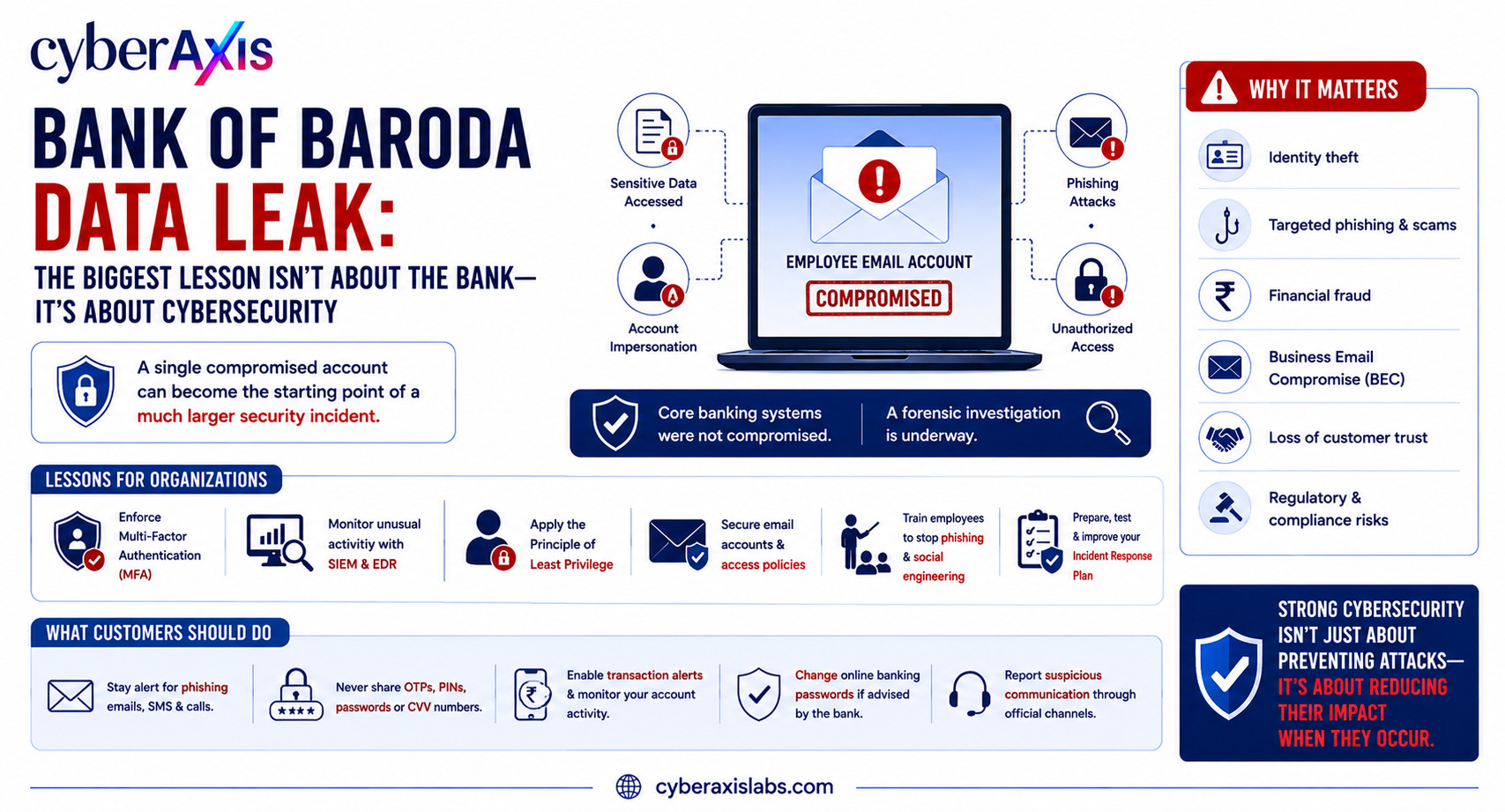
Recently, reports emerged of an alleged data leak involving Bank of Baroda, raising concerns among customers and the cybersecurity community.
According to the bank's official statement, the incident involved the compromise of an employee's email account, resulting in unauthorized access to certain data. The bank also stated that its core banking systems were not compromised and that a forensic investigation is underway.
Regardless of the final investigation findings, the incident highlights an important reality:
A single compromised account can become the starting point of a much larger security incident.
What Can We Learn?
Many organizations invest heavily in firewalls, endpoint protection, and network security.
However, attackers don't always target the most heavily protected systems.
Sometimes, they target something much simpler—an employee account.
If an attacker gains access to a business email account, they may be able to:
Access sensitive documents.
Gather internal business information.
Impersonate employees.
Launch phishing attacks from trusted accounts.
Move deeper into the organization's environment.
Cybersecurity isn't only about protecting servers.
It's also about protecting identities.
Why This Matters
Even if critical infrastructure remains secure, unauthorized access to business data can still create serious risks, including:
Identity theft.
Targeted phishing and scam campaigns.
Financial fraud.
Business Email Compromise (BEC).
Loss of customer trust.
Regulatory and compliance challenges.
That's why organizations must focus on both prevention and rapid detection.
Lessons for Organizations
Every organization—not just banks—should:
Enforce Multi-Factor Authentication (MFA) for all business accounts.
Monitor unusual login activity using SIEM and EDR solutions.
Apply the Principle of Least Privilege.
Train employees to recognize phishing and social engineering attacks.
Secure email accounts with strong authentication and conditional access policies.
Continuously monitor for suspicious activity.
Conduct regular security awareness training and penetration testing.
Maintain an incident response plan and perform regular security audits.
Cybersecurity is not a one-time implementation.
It's an ongoing process of monitoring, improving, and responding.
What Should Customers Do?
While organizations investigate security incidents, customers should also take precautions:
Stay alert for phishing emails, SMS messages, and phone calls claiming to be from the bank.
Never share OTPs, PINs, passwords, or CVV numbers.
Change online banking passwords if advised by the bank.
Enable transaction alerts and monitor account activity regularly.
Report suspicious communication immediately through official banking channels.
Many attackers exploit publicized data breaches by launching convincing phishing campaigns.
Final Thoughts
Every cybersecurity incident reminds us that security isn't defined by whether an attack occurs—it's defined by how quickly it is detected, contained, and responded to.
The Bank of Baroda incident is another reminder that protecting an organization requires more than securing infrastructure. It requires protecting employee accounts, monitoring continuously, and preparing for incidents before they happen.
For organizations, the lesson is clear:
Strong cybersecurity isn't just about preventing attacks—it's about reducing their impact when they occur.

Comments 0
Email-verified comments are reviewed before they are published.