
Security Awareness
SIM Swapping Explained
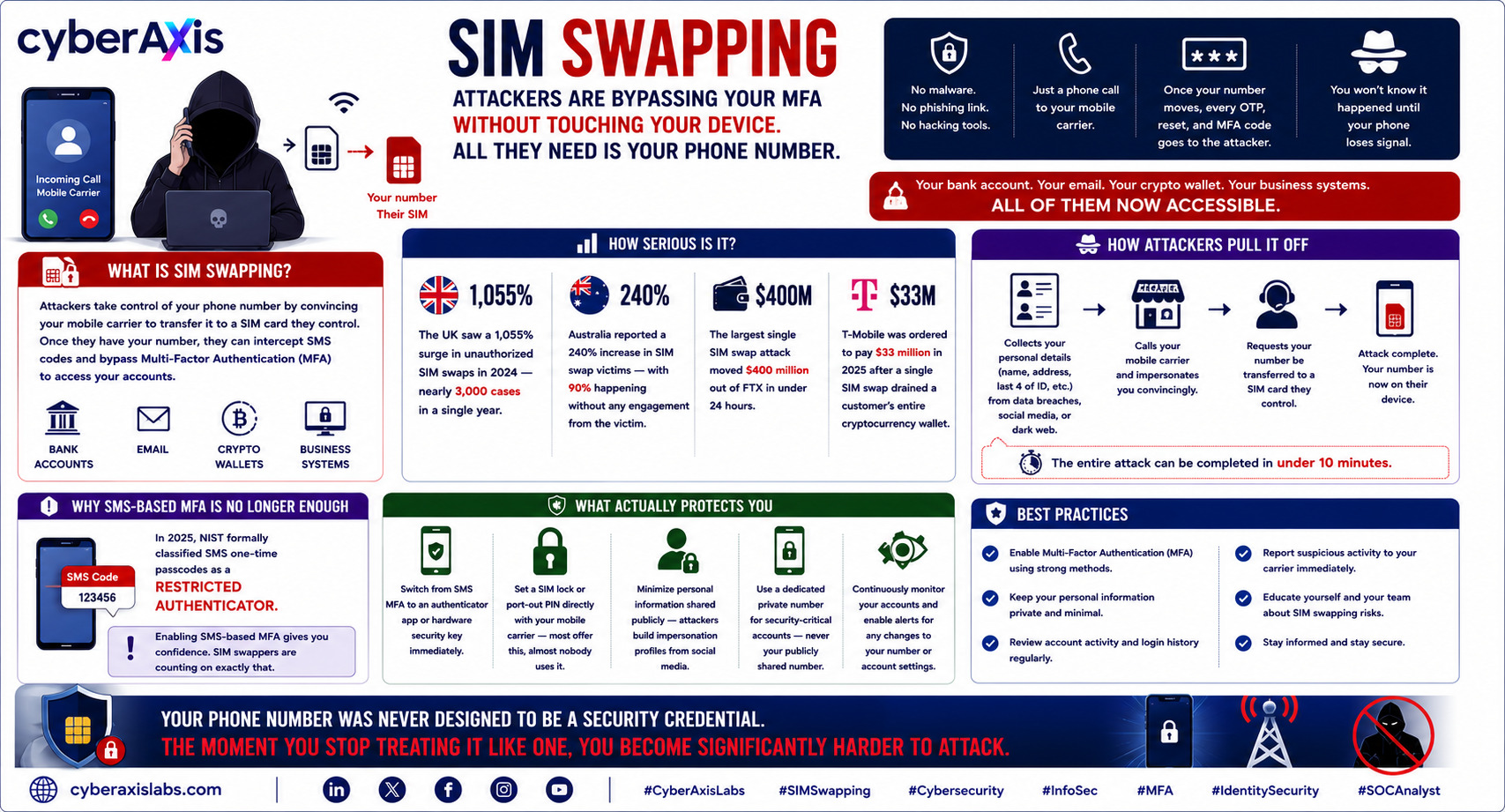
Attackers Are Bypassing Your MFA Without Touching Your Device. All They Need Is Your Phone Number.
No malware. No phishing link. No hacking tools.
Just a phone call to your mobile carrier — and your number is theirs.
Once your number moves to their device, every OTP, every password reset, every MFA code goes directly to the attacker. Not you.
Your bank account. Your email. Your crypto wallet. Your business systems.
All of them now accessible through a phone number the attacker controls.
And you won't know it happened until your phone loses signal.
This is SIM Swapping — and it is ranked among the top cyber threats reported to the FBI in 2025.
How serious is it:
→ The UK saw a 1,055% surge in unauthorized SIM swaps in 2024 — nearly 3,000 cases in a single year
→ Australia reported a 240% increase in SIM swap victims — with 90% happening without any engagement from the victim
→ The largest single SIM swap attack moved $400 million out of FTX in under 24 hours
→ T-Mobile was ordered to pay $33 million in 2025 after a single SIM swap drained a customer's entire cryptocurrency wallet
How attackers pull it off:
Attackers collect your personal details — name, address, last four digits of your ID — from data breaches, social media, or dark web markets. They call your mobile carrier, impersonate you convincingly, and request your number transferred to a SIM card they control.
The entire attack can be completed in under 10 minutes.
Why SMS-based MFA is no longer enough:
In 2025, NIST formally classified SMS one-time passcodes as a restricted authenticator — meaning SMS MFA is no longer considered a strong security control.
Enabling SMS-based MFA gives you confidence. SIM swappers are counting on exactly that.
What actually protects you:
→ Switch from SMS MFA to an authenticator app or hardware security key immediately→ Set a SIM lock or port-out PIN directly with your mobile carrier — most offer this, almost nobody uses it
→ Minimize personal information shared publicly — attackers build impersonation profiles from social media
→ Use a dedicated private number for security-critical accounts — never your publicly shared number
Your phone number was never designed to be a security credential.
The moment you stop treating it like one, you become significantly harder to attack.
cyberaxislabs.com
#CyberAxisLabs #SIMSwapping #Cybersecurity #InfoSec #MFA #IdentitySecurity #SOC
We appreciate your feedback - share your comments at [email protected]
Comments 0
Email-verified comments are reviewed before they are published.