
Shadow IT
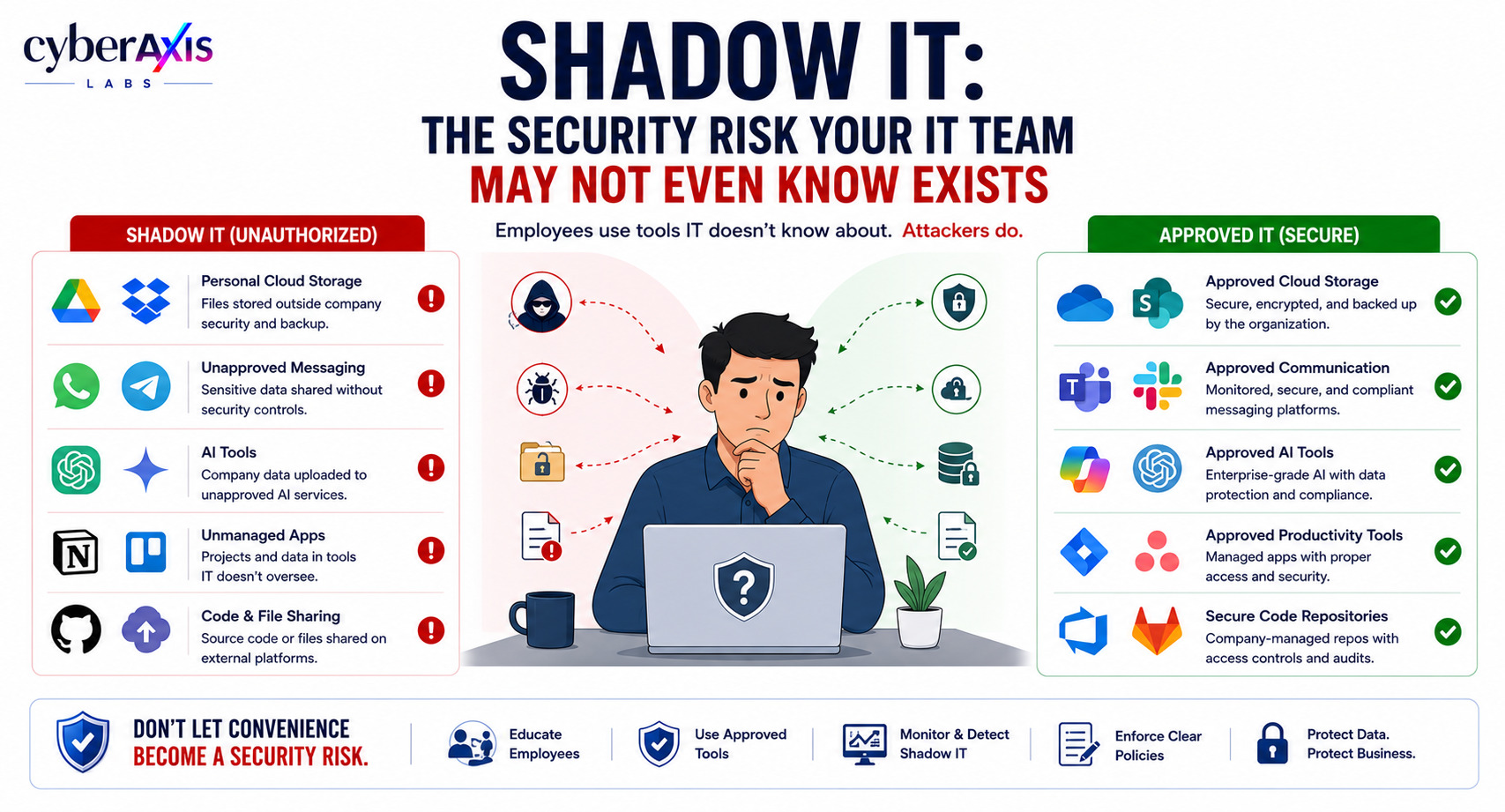
Shadow IT: The Security Risk Your IT Team May Not Even Know Exists
When people think about cybersecurity threats, they often imagine hackers, ransomware, or phishing emails.
But sometimes, the biggest security risk comes from well-intentioned employees trying to get their work done faster.
This is known as Shadow IT.
Shadow IT refers to employees using unauthorized applications, cloud services, devices, or software without the knowledge or approval of the IT department.
Most employees aren't trying to break company policy.
They're simply looking for tools that help them work more efficiently.
Unfortunately, convenience can introduce significant security risks.
What Is Shadow IT?
Shadow IT includes any technology used for work that hasn't been reviewed, approved, or managed by the organization's IT or Security team.
Common examples include:
Saving company files to a personal Google Drive or Dropbox account.
Sharing confidential documents through WhatsApp or Telegram.
Uploading company data to AI tools without approval.
Using personal email accounts for business communication.
Creating projects in Trello, Notion, or Asana without IT oversight.
Storing company source code in personal GitHub repositories.
Installing browser extensions without approval.
Using unauthorized file-sharing platforms such as WeTransfer.
While these tools may improve productivity, they often bypass security controls, monitoring, backup policies, and compliance requirements.
Why Is Shadow IT Dangerous?
Because IT teams cannot protect what they don't know exists.
Unauthorized applications may:
Store sensitive company data without encryption.
Lack Multi-Factor Authentication (MFA).
Be shared with unauthorized users.
Operate outside company backup policies.
Introduce malware through unverified software.
Create compliance and regulatory risks.
Even trusted applications can become security risks when used outside approved processes.
Scenario 1 – Personal Cloud Storage
An employee needs to work from home and uploads confidential financial reports to their personal Google Drive because it's easier to access from multiple devices.
Months later, the employee accidentally shares the folder publicly.
Sensitive company financial information becomes accessible to anyone with the link.
Lesson: Company data should only be stored in approved and managed cloud storage platforms.
Scenario 2 – AI Assistant
A software developer uses a public AI chatbot to troubleshoot an application error.
To get better answers, they paste proprietary source code, API keys, database queries, and internal architecture details into the AI tool.
Although the developer only intended to solve a technical problem, confidential company information has now been shared with an external service that was never approved by the organization.
Lesson: Employees should never upload confidential business data, source code, credentials, or customer information into unapproved AI tools.
Why Shadow IT Is Growing
Shadow IT has increased because employees want faster and more flexible ways to work.
Modern technologies make it easy to sign up for new services in minutes without involving IT.
This includes:
AI assistants
Cloud storage platforms
Collaboration tools
Project management software
Browser extensions
File-sharing services
Without proper governance, these tools can quietly expand an organization's attack surface.
How Can Organizations Reduce Shadow IT?
Organizations should:
Maintain an approved software catalog.
Educate employees about Shadow IT risks.
Provide secure alternatives that meet business needs.
Monitor cloud applications and SaaS usage.
Implement Data Loss Prevention (DLP) policies.
Use Cloud Access Security Broker (CASB) solutions where appropriate.
Restrict unauthorized software installations.
Review browser extensions and third-party integrations regularly.
Establish clear policies for AI usage and data sharing.
The goal isn't to stop innovation—it's to ensure new tools are introduced securely.
Final Thoughts
Shadow IT doesn't usually begin with malicious intent.
It begins with convenience.
A single unauthorized cloud account, browser extension, AI tool, or file-sharing service can expose confidential business data without anyone realizing it.
Organizations that combine employee awareness with clear security policies and approved alternatives are far better positioned to reduce this risk.
Remember: If IT doesn't know a tool exists, it can't secure it.



Comments 0
Email-verified comments are reviewed before they are published.