
Security Awareness
Social Media Risk
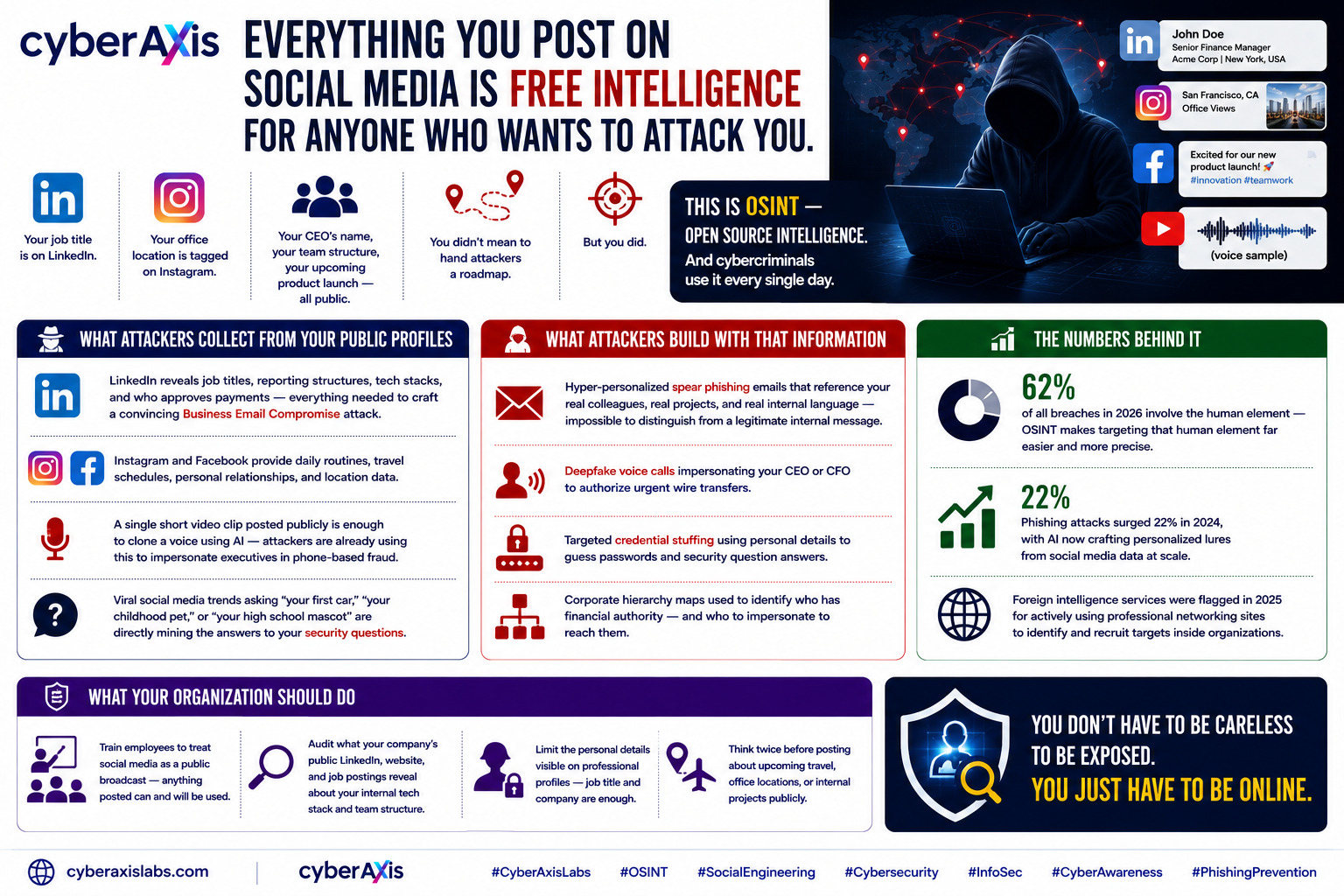
Everything You Post on Social Media Is Free Intelligence for Anyone Who Wants to Attack You.
Your job title is on LinkedIn.
Your office location is tagged on Instagram.
Your CEO's name, your team structure, your upcoming product launch — all public.
You didn't mean to hand attackers a roadmap.
But you did.
This is OSINT — Open Source Intelligence. And cybercriminals use it every single day.
What attackers collect from your public profiles:
→ LinkedIn reveals job titles, reporting structures, tech stacks, and who approves payments — everything needed to craft a convincing Business Email Compromise attack
→ Instagram and Facebook provide daily routines, travel schedules, personal relationships, and location data
→ A single short video clip posted publicly is enough to clone a voice using AI — attackers are already using this to impersonate executives in phone-based fraud
→ Viral social media trends asking "your first car," "your childhood pet," or "your high school mascot" are directly mining the answers to your security questions
What attackers build with that information:
✦ Hyper-personalized spear phishing emails that reference your real colleagues, real projects, and real internal language — impossible to distinguish from a legitimate internal message
✦ Deepfake voice calls impersonating your CEO or CFO to authorize urgent wire transfers
✦ Targeted credential stuffing using personal details to guess passwords and security question answers
✦ Corporate hierarchy maps used to identify who has financial authority — and who to impersonate to reach them
The numbers behind it:
→ 62% of all breaches in 2026 involve the human element — OSINT makes targeting that human element far easier and more precise
→ Phishing attacks surged 22% in 2024, with AI now crafting personalized lures from social media data at scale
→ Foreign intelligence services were flagged in 2025 for actively using professional networking sites to identify and recruit targets inside organizations
What your organization should do:
→ Train employees to treat social media as a public broadcast — anything posted can and will be used
→ Audit what your company's public LinkedIn, website, and job postings reveal about your internal tech stack and team structure
→ Limit the personal details visible on professional profiles — job title and company are enough
→ Think twice before posting about upcoming travel, office locations, or internal projects publicly
You don't have to be careless to be exposed. You just have to be online.
cyberaxislabs.com
#CyberAxisLabs #OSINT #SocialEngineering #Cybersecurity #InfoSec #CyberAwareness #PhishingPrevention
We appreciate your feedback - share your comments at [email protected]


Comments 0
Email-verified comments are reviewed before they are published.