
IT Infrastructure
DNS: Silent Redirect Risk
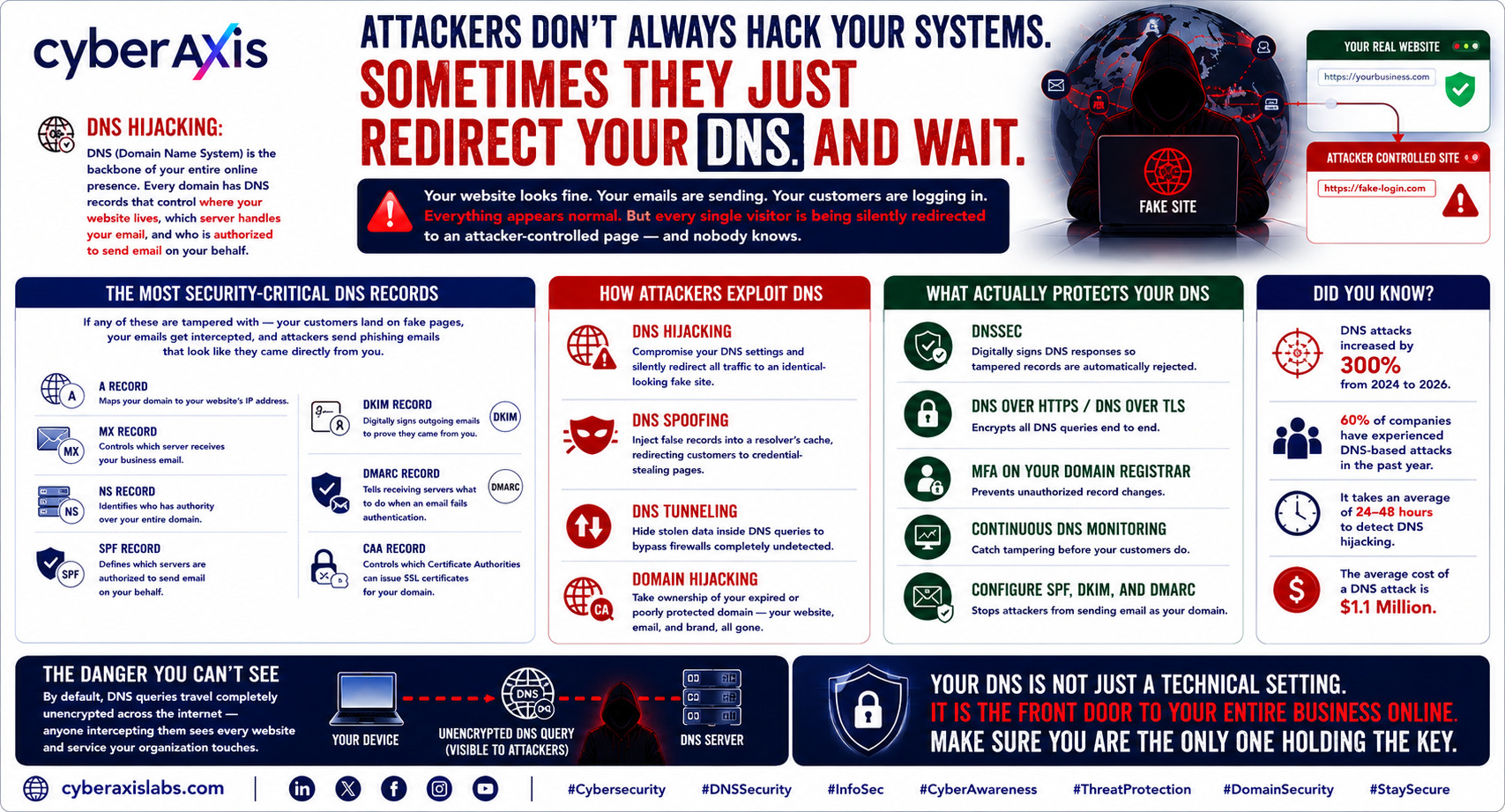
Attackers Don't Always Hack Your Systems. Sometimes They Just Redirect Your DNS and Wait.
Your website looks fine.Your emails are sending.
Your customers are logging in.
Everything appears normal. But every single visitor is being silently redirected to an attacker-controlled page — and nobody knows.
This is DNS hijacking. And it is one of the most dangerous and least talked about attack vectors in cybersecurity today.
What is DNS and why attackers love it:
DNS — Domain Name System — is the backbone of your entire online presence. Every domain has DNS records that control where your website lives, which server handles your email, and who is authorized to send email on your behalf.The most security-critical records every business must protect:
→ A Record — maps your domain to your website's IP address
→ MX Record — controls which server receives your business email
→ NS Record — identifies who has authority over your entire domain
→ SPF Record — defines which servers are authorized to send email on your behalf
→ DKIM Record — digitally signs outgoing emails to prove they came from you
→ DMARC Record — tells receiving servers what to do when an email fails authentication
→ CAA Record — controls which authorities can issue SSL certificates for your domain
If any of these are tampered with — your customers land on fake pages, your emails get intercepted, and attackers send phishing emails that look like they came directly from you.
How attackers exploit DNS:
- DNS Hijacking — compromise your DNS settings and silently redirect all traffic to an identical-looking fake siteDNS Spoofing — inject false records into a resolver's cache, redirecting customers to credential-stealing pages
- DNS Tunneling — hide stolen data inside DNS queries to bypass firewalls completely undetected
- Domain Hijacking — take ownership of your expired or poorly protected domain — your website, email, and brand, all gone
- By default, DNS queries travel completely unencrypted across the internet — anyone intercepting them sees every website and service your organization touches.
What actually protects your DNS:
→ DNSSEC — digitally signs DNS responses so tampered records are automatically rejected
→ DNS over HTTPS or DNS over TLS — encrypts all DNS queries end to end
→ MFA on your domain registrar — prevents unauthorized record changes
→ Continuous DNS monitoring — catch tampering before your customers do
→ Configure SPF, DKIM, and DMARC — stops attackers from sending email as your domain
Your DNS is not just a technical setting. It is the front door to your entire business online.
Make sure you are the only one holding the key.
cyberaxislabs.com
#CyberAxisLabs #DNS #DNSSecurity #Cybersecurity #InfoSec #NetworkSecurity #SOC #CyberAwareness
We appreciate your feedback - share your comments at [email protected]


Comments 0
Email-verified comments are reviewed before they are published.